
By Muhammad Shakeel · Oct 19, 2026 · 13 min read
A good monthly seo report shows traffic, rankings, enquiries, links, and actions taken, not vanity numbers. Here are the 5 things to demand every month.
A good monthly seo report shows traffic, rankings, enquiries, links, and actions taken, not vanity numbers. Here are the 5 things to demand every month.
Why most monthly reports fail
Every month, agencies send reports. Most of them fail for the same reason: they list every seo report metric the tools can measure instead of the few that matter. A Databox study found that 46% of companies track 3 to 5 primary SEO metrics, and that restraint is exactly right. A report is not a dashboard. A dashboard monitors continuously; a monthly report explains what changed, why it changed, and what happens next.
I have been sending these reports since 2013, first as a freelancer through 300+ Upwork jobs, now as an agency founder. Rank Rays reports website metrics only: rankings, traffic, links, and the visible enquiries they produce. No financials, no lead attribution, no invented revenue lines. That honest boundary shapes everything below.
So, what should an seo report include? The 5 things below.
1. Organic traffic: visits AND impressions, month-over-month AND year-over-year
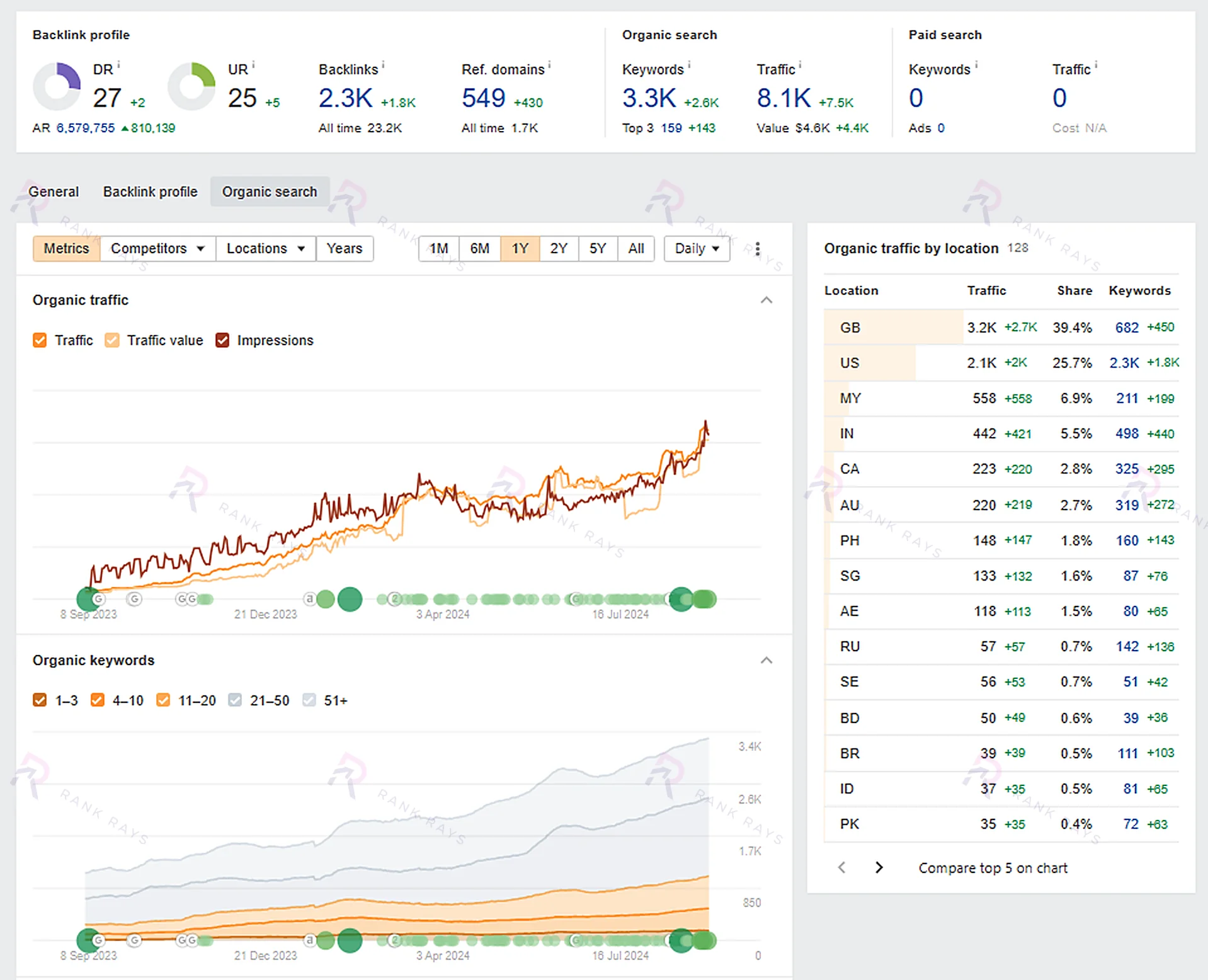
Traffic is the headline number, but most reports show it wrong. They show one number, visits, for one period, this month versus last. A real traffic section shows two numbers across two comparisons: visits (sessions from organic search) and impressions (how often the site appeared in search results), compared month-over-month and year-over-year.
The year-over-year comparison is the one agencies skip, and it is the one that saves clients from false alarms. A plumber's site dips every December. A wedding photographer's site dips every winter. November versus October makes a seasonal dip look like a failure; this November versus last November makes it look like a normal year, so a real drop stands out.
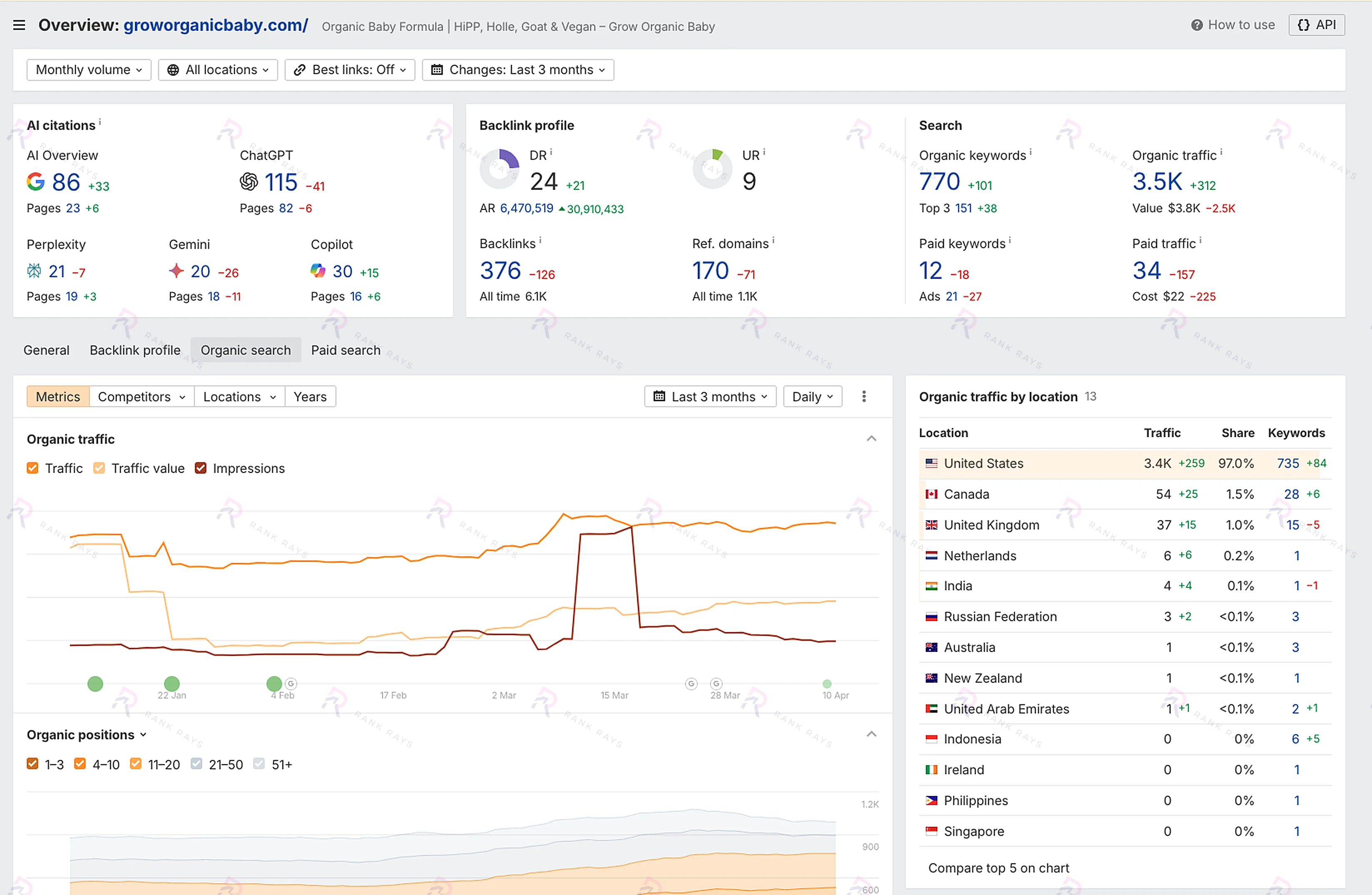
Then there is the new split no report covered before this year: AI search. In June 2026, Google added a dedicated Generative AI report to Search Console, announced by Hillel Maoz and Moshe Samet. It shows how often a site's pages appear inside AI Overviews and AI Mode, separate from the classic Performance report. This belongs in every monthly report from now on, with its limits stated plainly. The report gives impressions only. No clicks, no CTR, no average position, no query dimension, at least as of this writing. That is not a reason to ignore it. An Ahrefs study found organic click-through drops roughly 58% for top-ranking pages where AI Overviews appear: visibility and visits are no longer the same thing. If the report does not separate the two, a click decline reads as SEO failure when it is really a search-landscape change. October's Google announcement made this even more relevant: cited links now appear more prominently inside AI Overviews and AI Mode, and the link carousel is expanding worldwide.
The red flag version of this section is a report that shows only one traffic number, only one comparison, and no mention of where the clicks went. Demand visits and impressions, MoM and YoY, and the AI-visibility line from now on.

2. Keyword rankings that matter, verified against Search Console
Rankings still matter, but only the rankings that matter. Every site ranks for hundreds of phrases; the monthly report should track the ones that can bring customers. That means separating money keywords, the phrases buyers type when they are ready to hire, from informational keywords, the phrases readers type when they are learning. Both are worth tracking, but they answer different questions. Money keywords measure buyer intent; informational keywords measure reach. Averaging them produces a number that means nothing.
Two rules protect this section from fiction. First, daily fluctuations are normal noise. A keyword dropping 2 positions on a Tuesday is not an event; the report should read trends across weeks, not snapshots. Second, tracker numbers must be verified against Search Console. Rank trackers estimate positions from scraped SERPs, and scraped data breaks. Between September 17 and October 1, 2026, automated tools pulled incomplete SERP data during a Ranktracker release window, and agencies that trusted their dashboards reported phantom ranking drops that never happened in Search Console. Search Console is the source of truth; a tracker is a convenience. If a report shows a ranking change that Search Console does not, the tracker is wrong.
That discipline starts with keyword research built around real buyer intent. A money keyword at position 8 beats an informational keyword at position 1 every time, and the report should show that hierarchy, not hide it in an average.
Ask which 5 keywords could bring customers, and check those against the source of truth yourself.

3. Enquiries and form fills from organic: reported honestly
Here is the section the industry standard includes and most agencies inflate: conversions from organic. The honest version reports exactly what is visible, and names what it is not.
What we actually report: the number of enquiries and form fills that arrived through organic search. If the form has a traffic-source field or analytics can attribute a submission to organic, that number goes in the report. It is a real count of real people who found the site through search and asked for something, and it tells the client that organic search is producing visible contact, not just rankings.
What we do not report: revenue, lead quality scores, or attribution to client income. Our scope is website metrics only: rankings, traffic, links, and the enquiries they visibly produce. We do not track what happens after a form lands in the client's inbox; that is the client's sales process, not our SEO. Any agency that draws a line from a ranking to a revenue figure without CRM data showing the journey is inventing the line.
Enquiries also lag rankings. A page that reached position 3 last week has not had time to produce calls yet, and a report that shows rankings up but enquiries flat is reporting a pipeline in motion, not a failure. The month a page starts ranking is not the month it starts converting. If an agency ever promises enquiries on a schedule, that promise is the red flag.
SEO earns its keep by bringing in enquiries, and deciding how it stacks up next to paid ads is a legitimate question with a separate answer; we wrote a full comparison of seo vs ppc for that decision. The monthly report answers one question: is organic search producing more visible contact than before, and can we prove it with the data we actually have?
The red flag version of this section is a "conversions" number with no source, or worse, a revenue figure the agency cannot connect to a CRM. Demand the count, demand the source, and refuse the revenue line unless someone can show you the receipts.

4. Backlink profile changes: new and lost referring domains
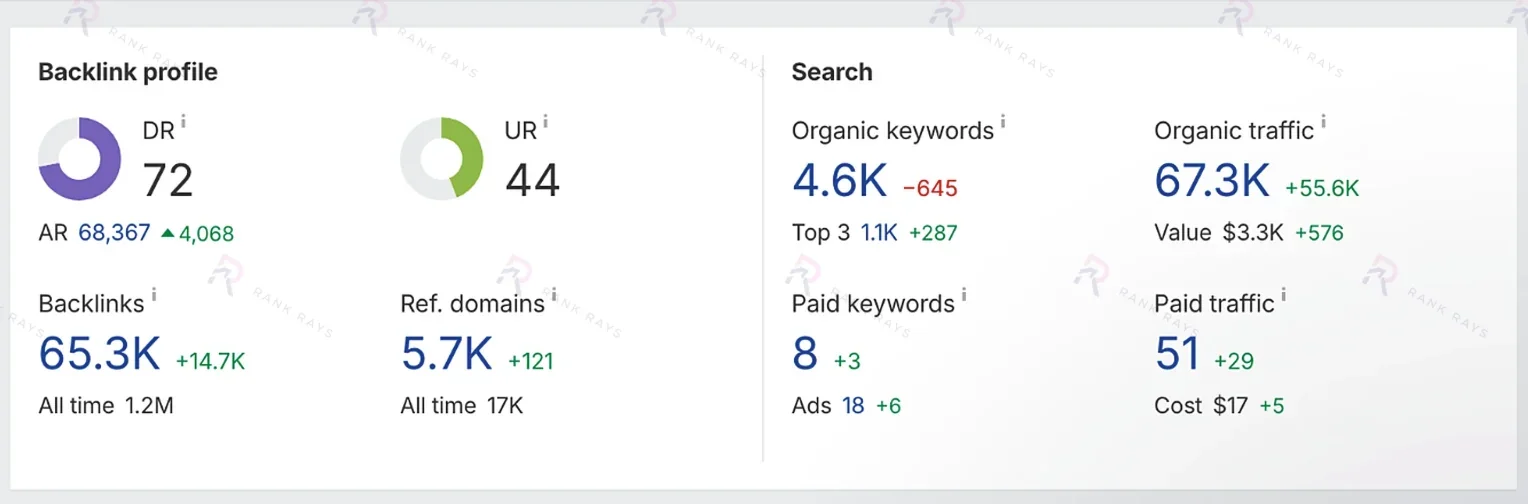
For any business paying for link building, this section is the proof of work. It has exactly two columns: referring domains gained this month, and referring domains lost this month. Not total links. Referring domains, the number of distinct websites linking to the site, because 50 links from one domain is one relationship, not 50.
New domains prove the campaign is producing. Lost domains prove the agency is watching. Links drop. Sites close, pages get rebuilt, webmasters remove old references. A lost referring domain is not automatically bad news, but an agency that never mentions the losses is not auditing the profile, it is decorating it. The report should name which domains arrived and which left, with the domain names visible, so the client can look at them and judge their quality directly.
Quality is the rest of this section. One link from a real, relevant publication beats 20 from directories nobody reads. Our authority bar is public: placements at DR 70+, DA 50+, and solid TF/CF metrics, and our authority packages carry a 3-month replacement guarantee because links occasionally drop and a provider should stand behind the work. Your report should state the bar the same way. If the new domains are coupon sites, link farms, and irrelevant blogs, the count going up is a warning, not a win.
This is also the section that connects to process. A gained domain should trace back to real work: manual outreach, a real article, a real editor. We run outreach from the client's own brand email, which gets better response rates and means every pitch and every reply is visible to the client. A report that shows new domains but cannot describe how each one was earned is asking for trust without evidence.
The red flag version of this section is a single big number, "127 new links this month," with no domain names, no distinction between domains and links, and no mention of anything lost. Demand the two columns, the domain names, and the quality bar in writing.

5. Technical health, actions taken, and what happens next
The most important section is the one most reports skip. Every report shows outcomes: traffic, rankings, links. Almost none shows inputs: what the agency actually did this month, what it found, and what it plans to do next. Outcomes without inputs are uninterpretable. If rankings rose and nothing was done, the rise was weather. If rankings rose and 3 technical fixes shipped, that is evidence.
The technical half of this section covers 3 things: crawl errors (pages Google tried to reach and could not), site speed (how fast key pages load, because slow pages leak both rankings and enquiries), and indexing (whether the pages that matter are actually in Google's index). The report should show the counts, the fixes applied, and the pages affected.
The actions half is a work log. Each line names the work, the pages, and the result: which internal links were fixed, how far a page's load time dropped, how many submitted pages made it into the index. Then the planned half names next month's items the same way: the remaining redirect chains, the thinnest service descriptions. If you use a monthly seo report template, add these two columns to it: what was done, what is next. A template without them is a scoreboard, not a report.
The technical baseline behind this section starts with a proper technical seo audit: crawl errors, speed, and indexing measured before anything is fixed, so every later report has something honest to compare against. The ongoing fixes, the technical seo work itself, then show up in this section month after month. That is what a retainer buys: not a report, but the work the report describes.
The red flag version of this section is 40 green checkmarks, "all checks passed," while index coverage quietly keeps dropping. Demand the work log, the real numbers, and next month's plan, in writing.

| Metric | Where the data comes from | What it actually proves | Common misuse |
|---|---|---|---|
| Organic sessions | GA4 | Whether total visits from organic search are growing or shrinking | Celebrating a traffic bump without checking where it came from |
| Clicks and impressions | Google Search Console | Whether search visibility is turning into actual visits | Treating impressions as visits; one impression is not a visitor |
| Keyword positions | Rank tracker, verified in Search Console | Whether the pages that can earn money are actually moving | Reporting 50 keywords when only 5 could bring a customer |
| AI-visibility impressions | GSC Generative AI report | Whether pages appear inside AI Overviews and AI Mode | Counting AI impressions as traffic; the report gives impressions only |
| Referring domains gained and lost | Backlink index or link tools | Whether the link profile is growing or quietly leaking | Counting links instead of referring domains; hiding the lost ones |
| Enquiries and form fills from organic | The site's own forms and call tracking | Whether organic search is producing visible contact | Claiming revenue attribution without CRM data to back it up |
| Technical issues found and fixed | Crawl data and Search Console coverage | Whether the site is getting healthier, not just monitored | Listing 40 "checks passed" while index coverage keeps dropping |
| Actions taken and planned | The agency's own work log | What was actually done this month and what happens next | A report of outcomes with no inputs: numbers without the work behind them |
FAQ
What is the single most important metric in an SEO report?
There is no single one, which is exactly the point. If forced to pick a headline, take the organic traffic trend, visits and impressions across both month-over-month and year-over-year. Rankings without traffic is vanity, traffic without enquiries is reach without results, and one metric alone will always mislead you.
How often should I receive an SEO report?
Monthly. That is the right cadence for explaining what changed and deciding next actions. A dashboard is the wrong tool for that job; it monitors continuously but explains nothing. Many agencies give dashboard access for the day-to-day and a written report once a month. If your agency only gives you a live dashboard link and calls it a report, ask for the explanation in writing.
Why did my traffic drop when my rankings improved?
This is the AI-search split described in section 1. Your pages can hold or improve their rankings while AI Overviews answer the query above them, cutting the clicks those rankings used to earn. An Ahrefs study put that click loss near 58% for top-ranking pages where AI Overviews appear. Check the Generative AI report in Search Console: if AI-visibility impressions are rising while clicks fall, the rankings are fine and the landscape changed. That is a strategy question, not an SEO failure.
How many keywords should a monthly report track?
The ones that matter, not the ones that flatter. Separate money keywords from informational keywords, track both, and never let an average hide the difference. A Databox study found that 46% of companies track just 3 to 5 primary SEO metrics, and keyword tracking should follow the same discipline. 10 keywords you chose deliberately beat 100 you inherited from a tool.
Should an SEO report include revenue?
Only if someone can prove the connection. We do not include revenue, lead quality scores, or income attribution in our reports, because our scope is website metrics only and we do not run our clients' sales processes. A revenue line without CRM data behind it is invented. If an agency wants credit for revenue, ask to see the CRM records showing the journey from organic click to closed deal. Anything less is storytelling.
My rankings improved but enquiries stayed flat. Is the SEO working?
Probably, and the report should explain why the lag is normal. Rankings are a leading indicator; enquiries are a lagging one. A page that reached position 3 last week has not had time to convert yet. If the pages that rose are informational, they bring readers, not buyers. Check which type moved before judging the outcome.
What is the difference between a dashboard and a monthly report?
A dashboard monitors; a report explains and decides. The dashboard shows you the numbers every day. The monthly report tells you what changed, why it changed, what was done about it, and what happens next. You need both, but only the report gives you accountability. Now you know how to read an seo report either way: look for the explanation, not just the numbers.
Can my site appear in AI Overviews without getting any traffic?
Yes, and this is now normal. The Generative AI report in Search Console shows impressions inside AI Overviews and AI Mode, and it gives impressions only, no clicks. A page can be cited in AI answers regularly while sending few visits, especially since AI Overviews cut organic clicks by more than half on the pages they cover. Track that visibility separately from traffic.
The bottom line
A monthly report is an accountability document, not a scoreboard. Traffic with year-over-year context. Rankings for the keywords that matter, checked against Search Console. Enquiries counted honestly, with no invented revenue line. Backlinks gained and lost, with the domain names visible. And the work log: what was done, what was found, what happens next.
Hold any agency, including us, to that standard. We have been in SEO since 2013, and we report what we can actually see. If your current report shows you one traffic number, a wall of keywords, and 40 green checkmarks, you are not getting a report. You are getting a pacifier.
Get a free SEO audit and we will show you what a real one looks like: your traffic with proper context, your rankings against Search Console, your backlinks gained and lost, and an honest list of what we would do first.
Want this done for your site?
Reading helps, but rankings come from doing. Request a free SEO audit and our team will look at your actual site.